Your child already uses AI every day. On the phone. On YouTube. In games. Soon, they will use it for school work too. So many parents ask: should my child learn AI? Is it too hard? Where do we start?
This guide explains artificial intelligence in Nepal in simple words. You will learn what it is, where it is used, and how your child can start learning it, online or in person. You do not need to know anything about computers.
In short: AI is a computer that learns from examples. It is already used in Nepal. Children in Grade 7 to 10 can learn it step by step, even if they have never done any coding. At Young Crafts Academy, your child can join our AI course in Nepal online or in person, and you can try the first class free.
What Is Artificial Intelligence?
Artificial Intelligence (AI) is a technology that enables machines and computers to perform tasks that typically require human intelligence. It allows systems to learn from data, recognise patterns and make decisions to solve complex problems.
Simulates human intelligence through learning and reasoning.
Processes large amounts of data to identify patterns and insights.
Continuously improves performance using experience and feedback.
In Simple Words : Artificial intelligence (कृत्रिम बौद्धिकता) is a computer that learns from examples, the same way your child learned to read.
Think back to when your child learned the letter क. Nobody gave them a rule like "two lines and a curve". The teacher simply showed it again and again: in the book, on the whiteboard, in a friend's messy handwriting. Now your child can read क in any handwriting, even one they have never seen before.
AI learns the same way. We show a computer many examples: photos, sounds or words. It finds what they have in common, and then it can make a good guess about something new. That is all AI is. It is not magic, and it is not a person. It is a computer that has learned from many examples.
In our course, your child does exactly this in Step 2: they show the computer photos, teach it, and watch it learn.
Artificial Intelligence in Nepal: Is It Really Used?
Yes, and probably more than you think. AI is already at work in Nepali banks, restaurants, schools and even government plans:
● In banks: Machhapuchchhre Bank's AI assistant, Maya, answers customer questions 24 hours a day. Other banks in Nepal use AI chat assistants too.
● Robots made in Nepal: a Nepali company, Paaila Technology, built Pari, a robot that greeted customers at a bank in Kathmandu in 2017. It also built Ginger, robot waiters that served food at a Kathmandu restaurant. If your child loves robots, our Robotics Innovation course teaches them to build their own.
● Nepali AI jobs: Fusemachines, an AI company, has a team in Nepal that builds AI tools.
● Learning AI in Nepal: NAAMII, a research institute in Lalitpur, runs a Nepal AI School every year, where students learn AI. At Young Crafts Academy, children can start even earlier with our AI course for Grade 7 to 10.
● In our own language: translation and voice typing apps can now understand Nepali.
● Government plan: in August 2025, the Government of Nepal approved the National AI Policy 2082, a plan to grow AI in Nepal safely and fairly.
What does this mean for your child? AI is still new in Nepal, and the country will need many young people who understand it. Children who start learning now will be ahead, not behind. The easiest first step is a free 45-minute AI trial class.
The Current State of Artificial Intelligence in Nepal (2026)
Artificial Intelligence (AI) is becoming an important part of Nepal’s future. The government is planning to expand AI education, support technology companies and encourage research. For children growing up in a digital world, this creates exciting opportunities to learn, experiment and build new things.
Here is what is happening with AI in Nepal today and why it matters for your child.
1. Nepal Has a National AI Policy
In August 2025, the Government of Nepal approved the National Artificial Intelligence Policy 2082, a national plan to encourage the development and responsible use of AI.
The policy aims to:
Train 5,000 AI professionals within five years.
Increase the contribution of the IT sector to Nepal’s economy.
Improve Nepal’s position in the global AI Readiness Index.
Establish a National AI Centre to support AI research and development.
Encourage AI education and research through universities and research institutions across the country.
The policy identifies agriculture, healthcare, education, tourism, finance and public services as important areas for AI development.
What does this mean for children? Nepal will need people who understand AI, can solve problems and know how to use technology responsibly. Learning AI early can help children prepare for these future opportunities.
2. Nepal Is Investing in AI Technology
Nepal’s 2026/27 budget announced plans for a Sovereign AI Compute Centre in Syuchatar, Kathmandu. The initiative aims to provide computing resources for AI research, startups and other technology projects.
The budget also includes support for postgraduate AI research through scholarships and fellowships, alongside measures intended to encourage IT service exports.
These initiatives show that AI is becoming an important part of Nepal’s technology ambitions.
Children do not need expensive computers or advanced mathematics to begin learning AI. They can start with simple experiments, visual tools and beginner-friendly coding projects before gradually exploring more advanced concepts.
3. AI Is Creating New Opportunities in Nepal’s IT Sector
Nepal’s software development and IT services industry is growing, with companies increasingly exploring AI-powered applications and services.
Industry estimates from the Nepal Association for Software and IT Services (NAS-IT) put Nepal’s IT service exports at around USD 1 billion in 2025, compared with approximately USD 515 million in 2022.
AI-related work can involve machine learning, data engineering, automation, intelligent applications and preparing data for AI systems.
As these technologies become more common, the ability to understand AI and use it effectively can become a valuable skill.
For children, the goal is not to choose a career too early. It is to develop curiosity, logical thinking, creativity and problem-solving skills that can help them explore technology in the future.
4. Artificial Intelligence in Education: Is AI Coming to Nepal's Schools?
Nepal is exploring ways to bring AI and digital technology into school education. In 2026, the Curriculum Development Centre began work on curriculum revisions that include an AI and ICT thematic committee.
However, curriculum development takes time. Proposed changes must go through drafting and approval before new textbooks and classroom materials become widely available.
For now, access to structured AI education varies between schools.
Parents can help bridge this gap by encouraging children to explore AI through age-appropriate activities, guided experiments and practical projects outside the classroom.
For example, children can teach a simple computer model to recognise pictures, create a basic chatbot or use Python to explore how computers process information.
5. Challenges Nepal Must Overcome
Although AI offers exciting opportunities, Nepal still faces several challenges:
Skills shortage: More trained people are needed to develop, maintain and use AI systems.
Implementation: National policies need practical plans, funding and effective execution to achieve their goals.
Brain drain: Skilled professionals often move abroad for better education and career opportunities.
Technology infrastructure: Access to reliable internet, computing resources and digital education varies across communities.
Nepali-language data: AI tools may perform less reliably in Nepali or local languages when suitable training data and language resources are limited.
These challenges also create opportunities for the next generation. Young learners who develop strong foundations in coding, data, AI and responsible technology use can eventually contribute to solutions designed for Nepal’s needs.
Why Should Children Start Learning AI Today?
Nepal’s AI journey is still developing, which makes this an exciting time for children to explore the technology.
They can begin by understanding how AI works, experimenting with simple tools and creating small projects of their own. As they grow, they can progress towards programming, machine learning, robotics and more advanced AI applications.
The most important thing is to help children become more than just users of technology. They should learn to question AI-generated answers, recognise its limitations, think creatively and use it responsibly.
At Young Crafts Academy, children in Grade 7 to 10 can begin this journey through our AI course in Nepal, with guided, hands-on learning online or in Kathmandu. With the right support, curiosity can grow into practical skills that help them understand and shape the digital future. Book a free trial class to see how your child enjoys it.
Examples of Artificial Intelligence You Already Use Every Day
You may already be using AI. Here are some examples:
● Travelling: Google Maps shows which road has traffic.
● Family photos: your phone can show all the photos of one person together, like grandmother, because it can recognise faces.
● Videos and songs: YouTube and TikTok show videos and songs you may like.
● Calls and messages: your phone can turn speech into words, and one language into another.
● Opening your phone: face unlock knows your face.
Your child uses AI every day. Will they only use it, or will they also learn how it works and make things with it?
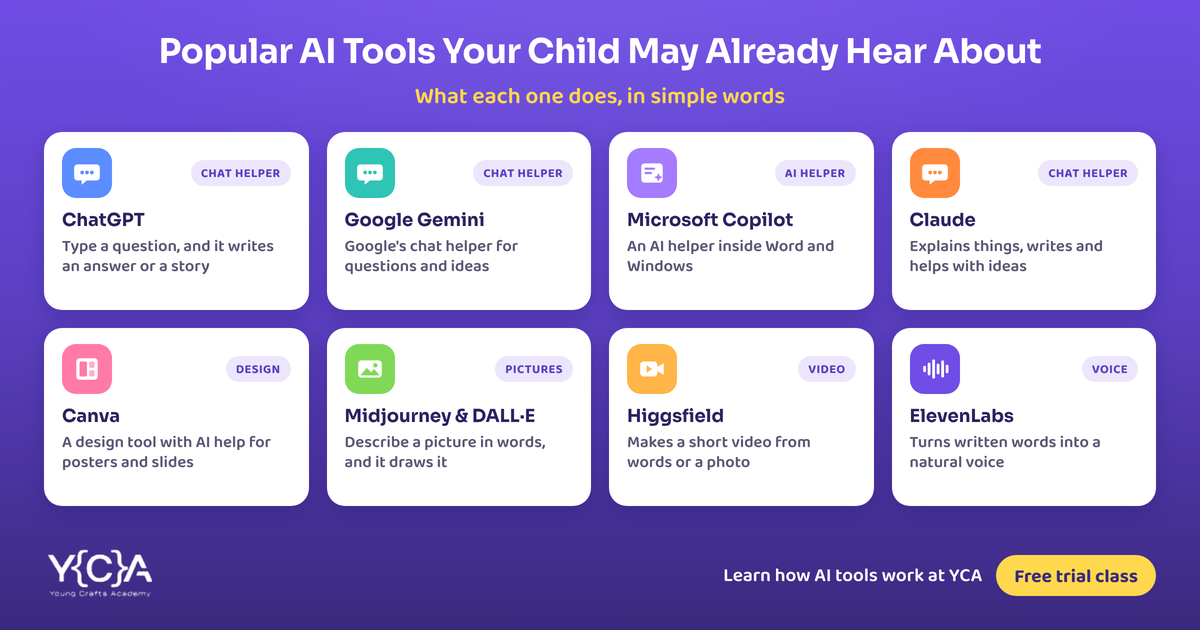
Popular AI Tools Your Child May Already Hear About
Many of these tools have minimum age rules, so check each tool's age limit and try them together with your child. You may have heard your child talk about AI tools like these. Here is what each one does, in simple words:
● ChatGPT: you type a question, and it writes an answer, a story or an essay.
● Google Gemini: Google's chat helper. It answers questions and helps with ideas.
● Microsoft Copilot: an AI helper inside Microsoft apps like Word and the Windows computer.
● Claude: another chat helper that can explain things, write and help with ideas.
● Canva: a design tool with AI features that help make posters and slides.
● Midjourney and DALL·E: you describe a picture in words, and they draw it.
● Higgsfield: you describe a scene or add a photo, and it makes a short video or picture.
● ElevenLabs: it turns written words into a natural-sounding voice, in many voices and languages.
These tools look like magic, but they use the same idea your child learns in our course: learning from many examples. In the course, your child learns how tools like these work, and then builds small versions of their own, such as a chat helper and an AI art maker.
If your child loves making videos and pictures with tools like these, our Video Editing course is another great fit.
One more thing for parents. Many AI tools have age rules, and they can give wrong answers. Some can also make very real-looking videos and voices, so children must learn to question what they see and hear. That is why we teach children to check answers and use AI the right way. Please read each tool's age rules before your child uses it.
The Importance of Artificial Intelligence for Your Child's Future
● A head start: AI is still new in Nepal. Children who learn it now will be ahead of others.
● Skills for the future: AI is starting to be used in banking, health, farming and design. A child who understands AI will not be afraid of it later.
● Using AI wisely: children already use AI apps and chat assistants. Learning how AI works helps them know when AI can be wrong and how to use it safely.
● Maker, not only user: instead of only watching videos and playing games, your child builds something of their own.
● Pride and confidence: your child ends the course with their own AI project to show you.
Want more reasons? Read our guide on why every child should learn coding in Nepal.
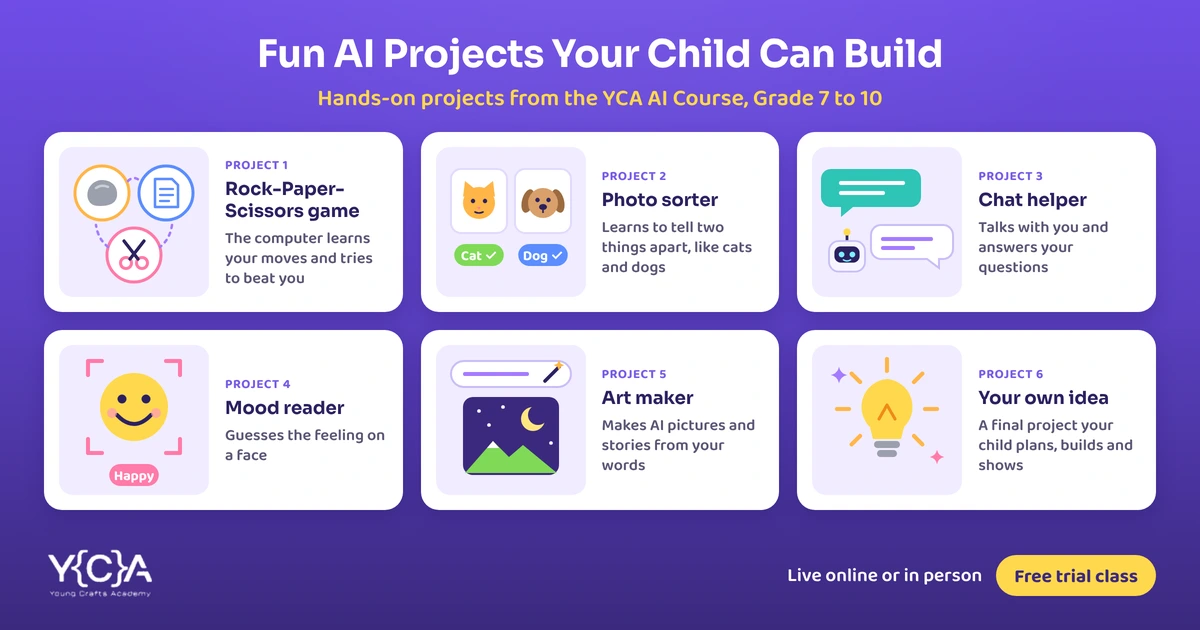
Fun AI Projects Your Child Can Build
These are some of the projects children make in the course. Each one is hands-on and fun.
● Rock-Paper-Scissors game: the computer learns your moves and tries to beat you.
● Photo sorter: learns to tell two things apart, like cats and dogs.
● Chat helper: talks with you and answers questions.
● Mood reader: guesses the feeling on a face.
● Art maker: makes AI pictures and stories.
● Their own idea: a final project that your child plans, builds and shows.
Looking for more ideas to try at home? See our 10 Python project ideas for kids in Nepal.
What Will Your Child Learn? 7 Steps in 45 Days
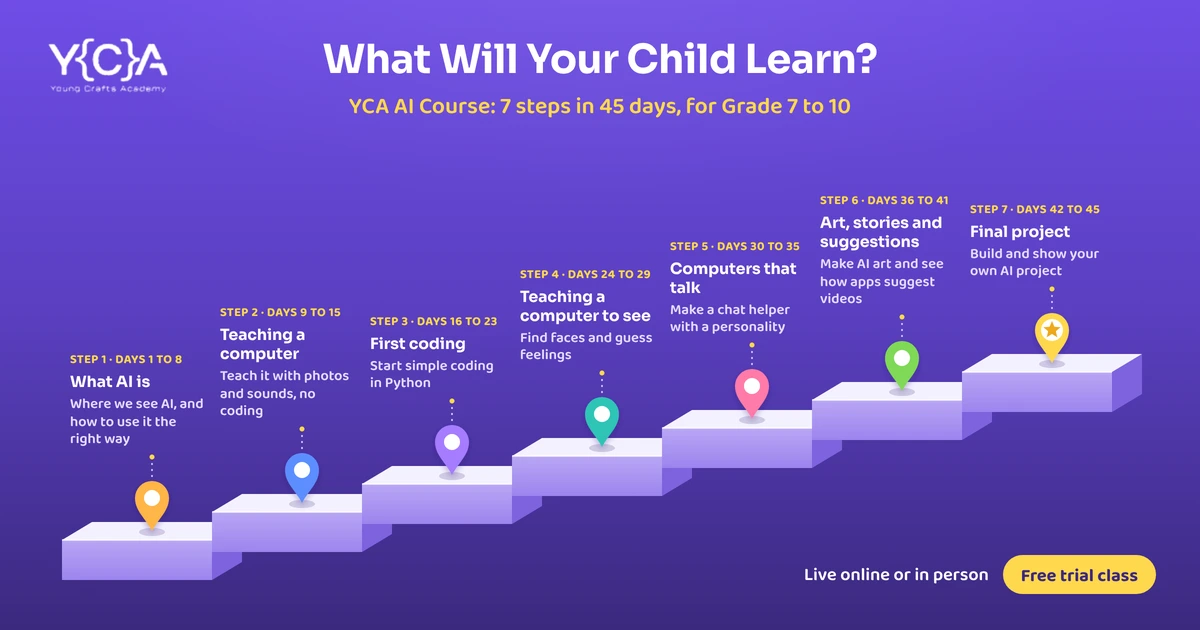
Looking for AI for kids in Nepal? The AI course in Nepal at Young Crafts Academy is for Grade 7 to 10. Your child does not need any coding experience. The course goes step by step, from the first idea to a final project.
Step and days | What your child learns | What your child does |
1. Days 1 to 8 | What AI is | Learns what AI is, where we see it every day, and how to use it the right way |
2. Days 9 to 15 | Teaching a computer | Teaches a computer using photos, sounds and body movements, with a simple tool and no coding |
3. Days 16 to 23 | First coding | Starts simple coding in Python (a beginner-friendly computer language) to make the computer guess answers |
4. Days 24 to 29 | Teaching a computer to see | Goes from finding faces in photos to a program that guesses the feeling on a face |
5. Days 30 to 35 | Computers that talk | Makes a chat helper that talks and has its own personality |
6. Days 36 to 41 | Art, stories and suggestions | Makes AI art and stories, and learns how apps like YouTube suggest videos |
7. Days 42 to 45 | Final project | Plans, builds and shows their own AI project |
Quick facts | Details |
Who it is for | Grade 7 to 10, beginners welcome |
How long | 45 days, one live 60-minute class each day |
Class size | Maximum 8 students, so every child gets attention |
Where | Live online from home, or in person at our centre in Sankhamul, Kathmandu |
Projects | 8 hands-on projects, from easy to harder |
Certificate | YCA AI Completion Certificate |
Teacher | Bhuwan Basnet, Lead Instructor for Robotics and AI (Electronics Engineering degree, 1.5 years of experience teaching kids) |
Free trial | One 45-minute class, no payment needed |
Is your child younger than Grade 7? They can start with Scratch Programming (Grade 1 to 4) or Python Programming (Grade 5 to 8), or you can see all YCA courses for kids. Has your child already learned Scratch? Read what comes after Scratch.
Can My Child Learn AI Without Coding?
Yes. Many parents ask this. Your child can start with no coding at all.
● Steps 1 and 2 have no coding: children use a simple tool. They show the computer photos or sounds, then test how well it learned. For example, they can teach it to tell cats from dogs.
● Coding starts in Step 3 (Days 16 to 23): by then, your child already understands the main idea, so coding feels easy and not scary. A short refresher is built in. Not sure if your child is ready? Read Is My Child Ready to Learn Python?
● After that: they use both to make the later projects.
Why this order? Children see something working in the first week, so they stay interested. When coding comes, they already know why they are learning it. Worried about maths? Read Does My Child Need to Be Good at Math to Learn Python?
AI Skills for Kids: What Your Child Will Gain
These skills help in any job and in daily life. AI is already starting to be used in banking, health, farming and design. A child who understands AI will not be afraid of it later.
Skill | What it means |
Understanding AI | Knowing what AI is, how it works and where it is used |
Understanding information | Seeing how the information we give a computer changes its answers |
Thinking carefully | Asking: is this answer correct? Is it fair? |
Solving problems | Trying, checking and improving until it works |
Creative ideas | Using AI to make art, stories and new ideas |
Using AI the right way | Knowing how to use AI fairly, safely and responsibly |
For parents, the most important may be thinking carefully and using AI the right way. Your child will use AI apps anyway. This course teaches them to ask: Is this answer right? Is it fair?
Learn Online or In Person: You Choose
Our AI classes for kids online and in person are made to fit your family. Both options are live with a teacher, and no more than 8 students are in a class.
● Online: your child learns live from home. There is no travel, and you can sit nearby.
● In person: your child learns at our centre in Sankhamul, Kathmandu, with the teacher and other students close by.
Not sure which is better for your child? Try a free class first and tell us if you prefer online or in person.
Is It Safe? Will It Increase Screen Time?
These are good worries. Here is how the course works:
● Classes are live with a teacher, with 8 students at most. Your child is not alone with a video.
● Each class is one hour. The time is spent making something, not scrolling.
● Children learn about AI safety from the first step, including that AI can make mistakes.
Not sure which course suits your child? Read our Parent's Guide to Coding by Grade or see all YCA courses.
Give Your Child a Head Start: Try a Free Class
The best way to decide is to watch your child try it. Sit next to them for 45 minutes. You will see what AI is, how the teacher explains it and how your child feels. If they enjoy it, you can start the full AI course.
Your child is already using AI. Help them understand it, build with it and be ready for the future. We would love to help.
Book a free 45-minute AI trial class. No payment needed. No coding experience needed. Online or in person.